
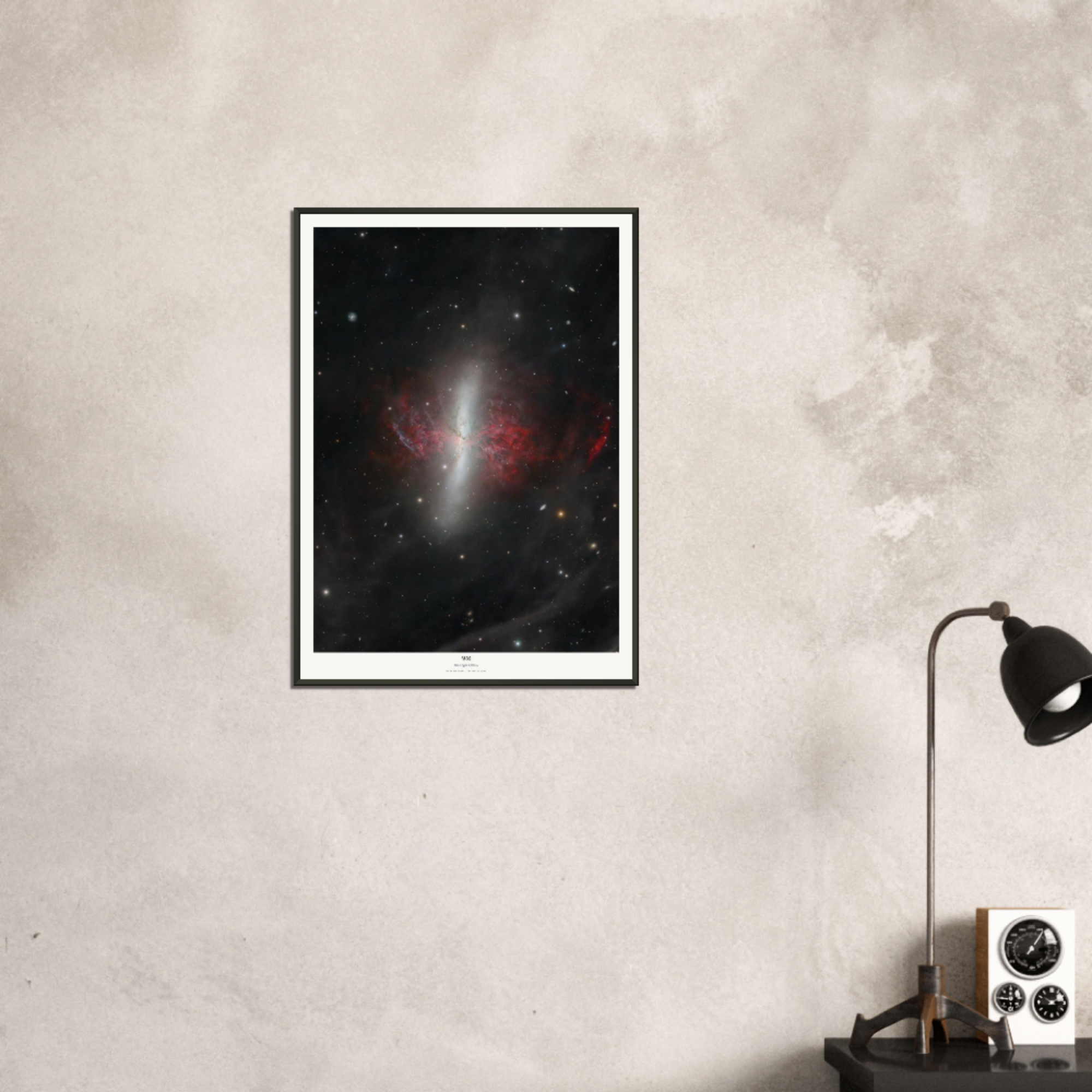
The Tulip Nebula; Petals and Shockwaves (Unframed)


£10.00
Prices include VAT
Selected: 21x29.7 cm / 8x12"
Express checkout
Apple Pay, Google Pay, and Shop Pay are available on the next screen.
This variant is currently out of stock.
Product details
Image DescriptionSh2-101 blooms softly against the backdrop of rich Cygnus star fields. Its sweeping arcs and flowing contours are sculpted by young, hot stars whose intense radiation is eroding and reshaping the surrounding gas. The nebula’s warm core is wrapped in delicately curving filaments, giving rise to the unmistakable “tulip” profile from which it gets its name. What appears gentle and floral is, in truth, the visible imprint of immense energy at work.Along the upper boundary of the field lies the interaction zone of Cygnus X-1, one of the Galaxy’s most studied X-ray binaries and long considered a prime black hole candidate. The system consists of a stellar-mass black hole accreting material from its O-type companion. As matter spirals inward, it produces powerful relativistic jets that punch into the surrounding interstellar medium.The bow shock visible here forms where one of these jets collides with denser hydrogen in the foreground arm of the Milky Way. The impact compresses and heats the gas, causing it to glow primarily in Oiii, which is why the structure appears here as an intense blue arc. The shock front is moving supersonically relative to the surrounding medium, creating a curved shell similar in principle to a boat’s bow wave, the difference being this is on a scale several light-years across!Most amateur images capture only the brightest segment of the shock, but with the depth of our dataset we are able to reveal a nearly closed elliptical shell, outlining the larger cavity excavated by the jet over thousands of years. This extended structure provides a rarer view of how the jet interacts with the interstellar medium and how the shock propagates outward from the central X-1 systemImaging SystemOur twin 130mm APO quadruplet refractors are mounted on a strong custom adaptor plate, riding securely on a Paramount ME. At the rear of each OTA is a rotator and EFW with complete Antlia LRGB + 3nm SHO filter sets, these in turn feed the photons into twin ASI2600MM Pro cameras. Though the Paramount is capable of unguided imaging, we opted for OAG to support dithering. Focus is automated for each OTA through ZWO EAFs. Power distribution and USB control is managed through a Pegasus UPB v3, with remote power strips and a UPS for redundancy.The system is hosted by PixelSkiesAstro remote observatory in Southern Spain where the roof frequently rolls off to a clear, dark sky. Both telescopes run in parallel, doubling the exposure time on target.We utilise NINA for an almost completely autonomous data acquisition solution, relying heavily on the Target Scheduler plugin to synchronise all three cameras and select the most suitable targets from our wish-list. SyncThing ensures the raw data is transferred overnight and waiting on our home PCs each morning, ready for backup and queued for calibration. The complexity of the rig is matched by an equally capable imaging server with redundant drives, ample memory and automated Discord status updates - keeping us both informed throughout the night.PrintOur premium semi-glossy paper enhances colours with a subtle shine and protects against fading from light or moisture: Paper Finishing: Semi-glossy, enhances colours with a subtle shine. Paper Weight: 200 gsm (80 lb), thickness: 0.22 mm (8.7 mils). Sustainable Paper: FSC-certified or equivalent paper for sustainability. Available Sizes: 21x29.7cm, 30x40cm and 50x70cm.
£10.00
You may also like
More prints from the gallery


SSL Secure Checkout
256-bit encryption
Colour Accuracy Guaranteed
Calibrated fine-art output
30-Day Money Back
No questions asked
Archival Quality
100+ year longevity